Conventions Are About Connections — So Why Is Information Sharing Still So Clunky?
Walk the floor of any trade show, industry conference, or professional convention and you will quickly notice something familiar: tables stacked with paper brochures, fishbowls full of business cards, and attendees juggling tote bags stuffed with flyers they will probably never read. For events whose entire purpose is to bring people together and spark meaningful business relationships, the way information gets exchanged has historically been surprisingly inefficient. That is changing fast, and QR Codes are at the center of that change.
The Real Goal of Any Convention
Whether it is a local chamber of commerce expo, a massive industry trade show like the Consumer Electronics Show (CES), or a regional healthcare summit, conventions exist for one core reason: to create a concentrated meeting point where professionals can make contacts, discover new solutions, and move their businesses forward. According to the Center for Exhibition Industry Research (CEIR), face-to-face interactions at trade shows continue to be among the most effective methods for generating qualified leads, with exhibitors reporting that a significant portion of their annual new business originates at live events. The meeting is easy — it is the follow-through that tends to fall apart, and that is exactly where QR Codes step in to close the loop.
From Paper Piles to Instant Digital Handoffs
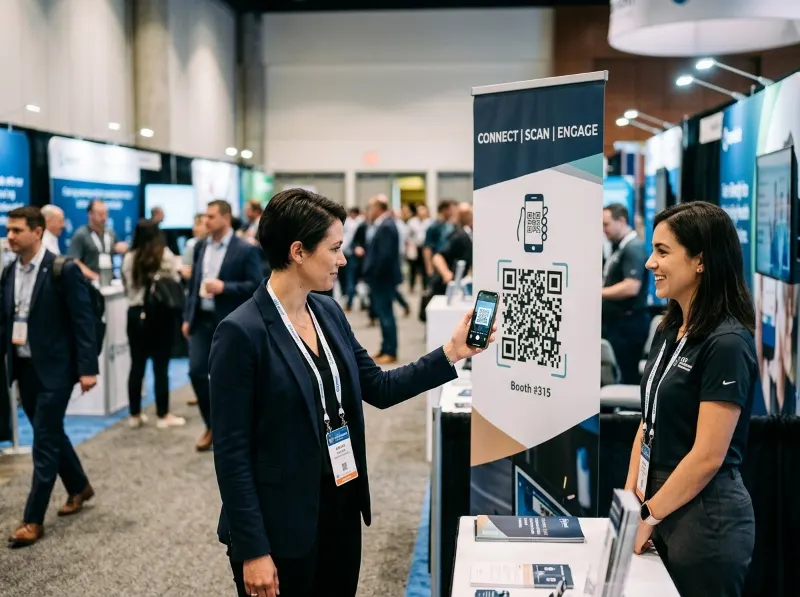
A QR Code solves a deceptively simple problem: how do you get the right information into someone's hands instantly, without requiring them to type a URL, remember a company name, or fish a crumpled card out of their pocket three days later? Exhibiting organizations can place a QR Code on their booth backdrop, tabletop display, product packaging, name badges, or even a branded pop-up banner. An attendee points their smartphone camera at the code and — in under two seconds — they are looking at a landing page, a digital product catalog, a company video, a contact form, or a calendar link to schedule a follow-up meeting. No app required, no friction, no delay.
Collecting Attendee Information Without the Awkward Card Shuffle
One of the most valuable things an exhibiting organization can do at a convention is capture qualified leads. Traditionally that meant scanning a badge with rented hardware, hoping the data export worked, or collecting business cards and manually entering them into a CRM later. QR Codes flip that dynamic. Organizations can display a QR Code that links directly to a lead-capture form — pre-built in tools like HubSpot, Mailchimp, or even a simple Google Form — so that an interested attendee can submit their own contact details on the spot. The data lands cleanly in whatever system the exhibitor uses, fully attributed to the event, and ready for follow-up before the show even closes.
Giving Attendees a Reason to Scan
Of course, a QR Code only works if people actually use it. The trick is giving attendees a compelling reason to pull out their phone. Smart exhibitors pair their codes with a clear call-to-action: "Scan to grab our free industry report," "Scan to enter our giveaway," or "Scan to see a live product demo video." When the value exchange is obvious, scan rates go up dramatically. This is not a new marketing principle — it is the same logic behind any good offer — but QR Codes make the delivery of that offer effortless and immediate in a convention environment where attention is scarce and time is short.
Dynamic QR Codes: The Secret Weapon for Convention Organizers
Here is something worth knowing if you are on the organizing side of a convention rather than the exhibiting side: dynamic QR Codes let you change the destination URL after the code has already been printed. That means you can print the conference program with a QR Code in January, and if the keynote speaker's session link changes in March, you simply update the destination — no reprint needed. Convention organizers are using dynamic codes to link attendees to real-time schedule updates, session recordings uploaded after a talk ends, interactive floor maps, and post-event survey forms. The same printed code serves multiple purposes across the lifecycle of the event.
Badge-to-Booth and Booth-to-Badge: Two-Way Communication
The communication loop at a convention runs in both directions, and QR Codes support both sides. Exhibitors use codes to push their information out to attendees. But attendees can also carry their own QR Code — printed on a name badge, a personal business card, or displayed on their phone screen — that links to their LinkedIn profile, personal website, or digital contact card. When two professionals meet at a booth, both can scan each other in seconds, and the exchange is complete, digital, and durable. Services that generate vCard QR Codes make this particularly easy, encoding a full contact record that drops straight into a phone's address book with a single scan.
Measuring What Actually Happened
One of the persistent frustrations of convention marketing has been the difficulty of measuring return on investment. You spend thousands of dollars on a booth, travel, and materials — but how many of those brochures actually led anywhere? QR Codes bring measurable analytics to an environment that historically had very few of them. Every scan is logged with a timestamp, a general geographic location, and the device type used. Organizations can see exactly how many people engaged with their booth code, at what times during the event traffic peaked, and which specific codes — product page, contact form, video link — drove the most interest. That data is gold for planning future events and refining the pitch.
Real-World Applications Across Convention Types
The use cases span every type of gathering imaginable:
- Trade Shows: Manufacturers link QR Codes to spec sheets, pricing guides, and dealer locator tools — eliminating the need for heavy printed catalogs.
- Medical & Healthcare Conferences: Pharmaceutical companies and device makers use codes to share clinical data, regulatory information, and HCP (healthcare provider) resources compliantly and quickly.
- Real Estate Expos: Agents and developers link codes to property listings, virtual tours, and mortgage calculator tools.
- Tech & Startup Summits: Founders use QR Codes on pitch decks and booth displays to share investor decks, demo videos, and funding round details.
- Non-Profit & Association Events: Organizations collect donations, membership sign-ups, and volunteer registrations through a single scannable link.
The common thread is simple: any time you need to move information from one party to another quickly and accurately, a QR Code makes it happen.
Keeping the Conversation Going After the Event
The real value of a convention is not always realized on the show floor — it is realized in the weeks that follow when relationships are deepened. QR Codes support that extended conversation too. An exhibitor can send a post-event email with a QR Code linking to a personalized "nice to meet you" landing page, a recorded version of their booth presentation, or a special offer valid only for people who visited them at the show. Because the lead data was already captured cleanly at the event, the follow-up is targeted and relevant rather than generic. The loop that opened when an attendee scanned a booth code gets closed when that same attendee becomes a customer or partner weeks later.
Getting Started Is Easier Than You Think
If your organization is heading into a convention season and you have not yet built a QR Code strategy, the good news is that the barrier to entry is extremely low. You do not need a large budget or a dedicated tech team. You need a reliable QR Code platform, a clear sense of what information you want to share, and a destination worth sending people to. QRSpike.com makes it straightforward to generate both static and dynamic QR Codes, track scan analytics, and manage multiple codes across different events or booth locations — all from a single dashboard. Whether you are an exhibitor trying to collect leads or a convention organizer trying to keep attendees informed in real time, having the right tool matters.
The Bottom Line
Conventions are investments — in time, in money, and in opportunity. The organizations that get the most out of them are the ones that make every touchpoint count, from the first glance at a booth display to the follow-up call three weeks later. QR Codes are not a gimmick or a novelty; they are a practical communication infrastructure that turns a brief in-person encounter into a lasting digital connection. If your convention strategy still relies primarily on paper handouts and business cards, it is time to close that loop. Start building smarter, more measurable convention experiences at QRSpike.com.
References
- Center for Exhibition Industry Research (CEIR) — Research and data on the trade show and exhibition industry.
- Consumer Electronics Show (CES) — One of the largest annual trade conventions in the United States, hosted by the Consumer Technology Association.
- QRSpike.com — QR Code generation, dynamic code management, and scan analytics platform.