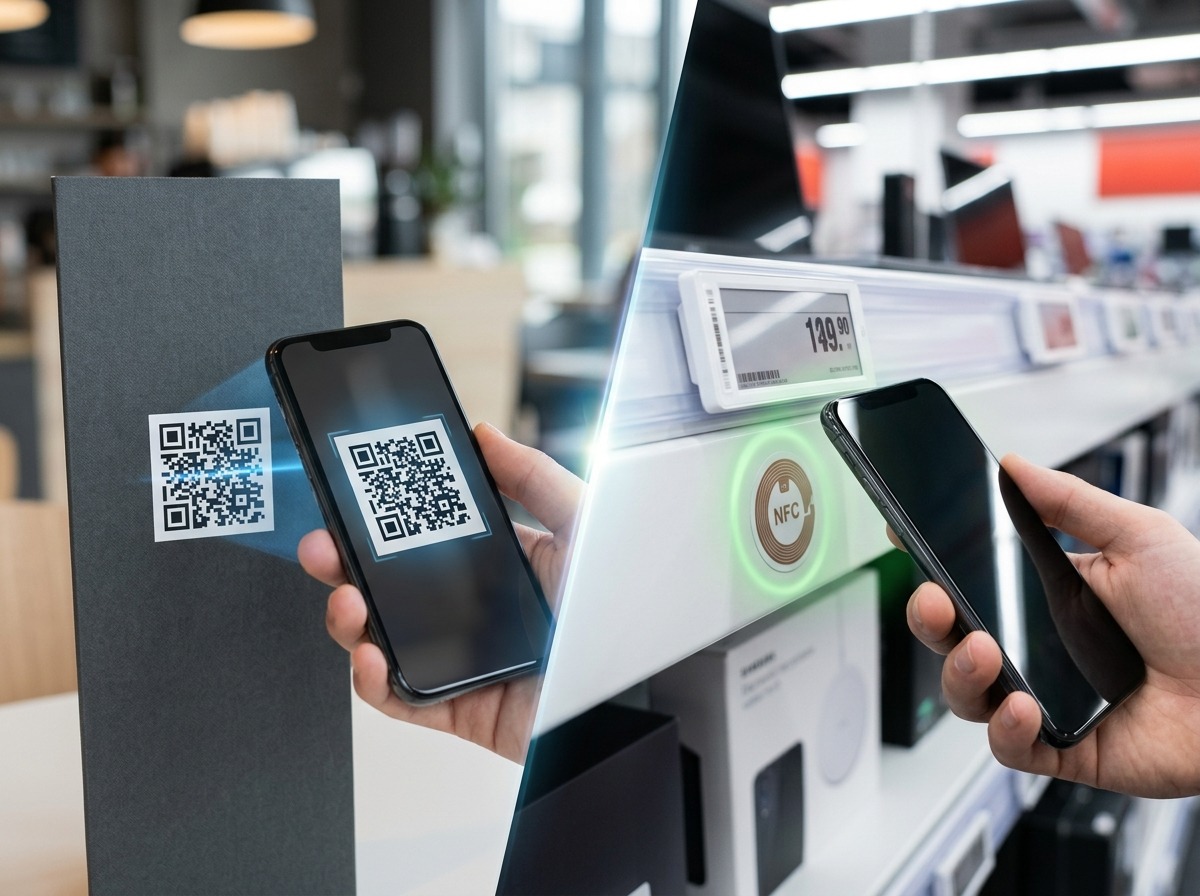
QR Code vs. NFC: The Showdown Every Business Owner Needs to See
If you've been researching ways to connect your physical world — think product packaging, signage, business cards, or retail displays — to a digital experience, you've probably run into two main contenders: QR codes and NFC (Near Field Communication) tags. Both are legitimate, proven technologies, and both can do some pretty impressive things for your business. But they work differently, cost differently, and serve different situations. So which one actually makes sense for you? Let's break it down clearly, without all the tech jargon.
What Are We Actually Talking About?
Before we compare them, let's get on the same page about what each technology actually is:
- QR Codes are those familiar square barcodes you scan with your smartphone camera. They store a URL or data that your phone reads optically — no special hardware required beyond the camera you already have in your pocket.
- NFC Tags are tiny chips embedded in stickers, cards, or products. When an NFC-enabled phone is tapped close to the chip (usually within an inch or two), it reads the stored data wirelessly — no camera needed, just a tap.
Both technologies can link a customer to a website, menu, payment page, loyalty program, or virtually any digital destination. The difference comes down to how they do it and what that costs you.
Cost: A Pretty Clear Winner
Let's talk money, because that's often the deciding factor for small and mid-sized businesses. QR codes are essentially free to generate. You create them digitally, print them on any surface — paper, packaging, stickers, banners — and you're done. The main cost is just printing. NFC tags, on the other hand, require physical chips. According to industry purchasing data, NFC tags typically run anywhere from $0.10 to over $1.00 per tag depending on memory size and quantity ordered, and that's before you factor in encoding and placement. For a business deploying hundreds or thousands of touchpoints, that adds up fast. For most small businesses just getting started with contactless engagement, QR codes win on cost — it's not even close.
Smartphone Compatibility: Closer Than You Think, But Still a Gap
This one surprises a lot of people. NFC has been around for years, but not every smartphone supports it — and even among those that do, user awareness of the tap-to-read feature is still relatively low outside of payment use cases like Apple Pay or Google Pay. QR codes, by contrast, are scannable by virtually every smartphone sold in the last several years. Apple added native QR scanning to the iOS camera app back in 2017, and Android followed suit broadly across major manufacturers. According to Statista, QR code usage in the U.S. surged dramatically during and after the COVID-19 pandemic and has held strong, with tens of millions of Americans scanning QR codes regularly. If you want the broadest possible reach with zero friction for your customers, QR codes still have the edge.
Where NFC Actually Shines
To be fair — and this is a real comparison, not a takedown — NFC does have some genuine advantages in specific scenarios:
- Premium product experiences: Luxury brands embed NFC chips in packaging or products to verify authenticity and deliver exclusive content. The "tap" feels more intentional and premium than scanning.
- Hands-free or low-light environments: Where pointing a camera is awkward — think a dark restaurant, a crowded event, or a product on a high shelf — a simple tap can be more intuitive.
- Access control and employee badging: NFC is the backbone of keycard systems and is well-suited for controlled access scenarios.
- Durability: NFC chips embedded in hard surfaces can withstand conditions that would destroy a printed QR code (think industrial or outdoor use).
If your use case fits one of those buckets, NFC deserves a serious look. But for most everyday business needs? The everyday flexibility of QR codes is hard to beat.
Ease of Setup and Management
Here's something businesses often overlook: what happens after you deploy? With a static QR code or NFC tag, if the destination URL changes, you're stuck reprinting or re-encoding everything. That's why dynamic QR codes are a game-changer for businesses. With a dynamic QR code, the printed code stays the same, but you can update the destination URL anytime from a dashboard — no reprinting required. Platforms like QRSpike.com offer dynamic QR code creation and management, so you can point your codes to new promotions, seasonal menus, updated product pages, or campaign landing pages whenever you need to. Dynamic NFC tags exist too, but managing them requires specialized software and is typically more complex and expensive to scale.
Tracking and Analytics: Know What's Working
A QR code that you can't measure is a missed opportunity. Both QR and NFC can be tracked, but again, QR has the practical advantage for most businesses. Dynamic QR code platforms provide real-time scan analytics — how many scans, from what locations, on what devices, at what times. This kind of data is incredibly valuable for understanding customer behavior and optimizing your campaigns. NFC tag analytics are available but typically require a dedicated platform and more technical setup. For a business owner who wants actionable insights without a steep learning curve, dynamic QR codes through a platform like QRSpike deliver a clean, straightforward analytics experience right out of the box.
Real-World Use Cases: Side by Side
Still on the fence? Here's how they stack up across some common business scenarios:
- Restaurant menus: QR codes — cheap, easy to update, customers are already used to them.
- Retail product packaging: QR codes for mainstream products; NFC for premium or luxury items where the tap experience adds brand value.
- Business cards: Both work well here. QR codes are cheaper to print; NFC cards feel more high-tech but cost significantly more per card.
- Events and conferences: QR codes for broad attendee engagement; NFC for VIP access or badge scanning where speed and hands-free matters.
- Industrial asset tracking: NFC wins — far more durable in harsh environments.
- Marketing campaigns: QR codes — easier to deploy at scale, track performance, and update in real time.
What the Market Is Saying
The market data continues to favor QR code adoption for mainstream business use. According to research cited by Forbes Advisor, QR code scans in the U.S. have grown consistently year over year, with food and beverage, retail, and marketing leading adoption. Meanwhile, NFC's primary commercial traction in the U.S. remains concentrated in payments (Apple Pay, Google Pay, contactless credit cards) rather than general marketing applications. That's not a knock on NFC — it's just a reflection of where consumer behavior and infrastructure actually are today. Businesses that deploy QR codes are meeting customers where they already are.
The Verdict: Start With QR, Scale as Needed
If you're trying to decide right now, here's the honest recommendation: start with QR codes. They're lower cost, require no special hardware, work with virtually every smartphone, are easy to manage and update, and offer solid analytics. For the vast majority of U.S. businesses — especially small and mid-sized ones — QR codes deliver everything you need to create seamless, trackable digital connections with your customers. As your business grows and your use cases get more specific, you can always layer in NFC for premium or specialized applications. But there's no reason to start complex when something simpler gets the job done better at a fraction of the cost.
Ready to get started? QRSpike.com makes it easy to create, manage, and track dynamic QR codes for your business — no technical expertise required. Whether you need one code or thousands, QRSpike has the tools to help you connect with customers smarter.
References
- Statista — QR code usage and scanning statistics in the United States: https://www.statista.com
- Forbes Advisor — QR Code Statistics: https://www.forbes.com/advisor/business/qr-code-statistics/